

How to Select Reliable CNC Machining Services and Prevent Costly Project Failures
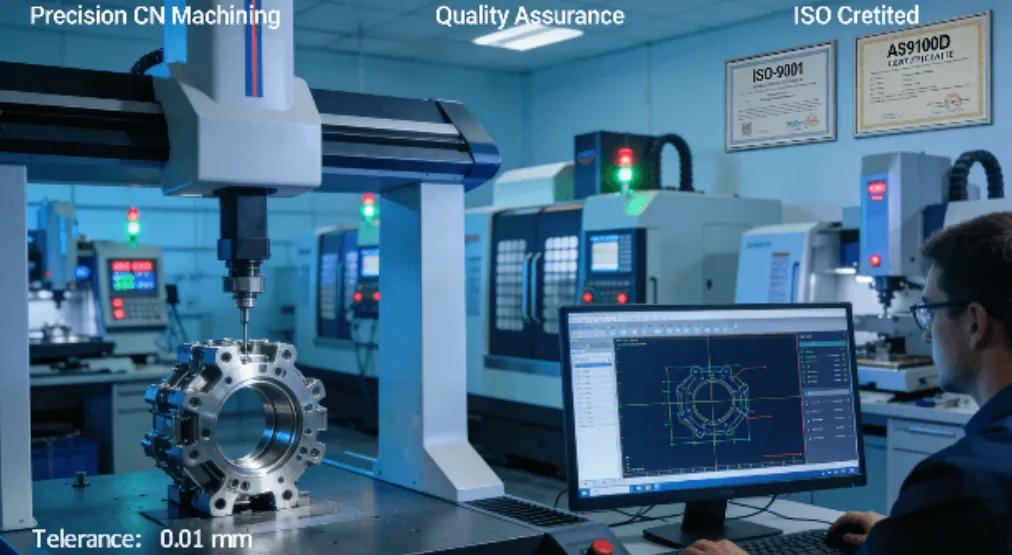
Figure 1: Advanced metrology lab in a certified CNC machining facility, showcasing rigorous quality assurance procedures including CMM inspection and real-time tolerance verification to ensure part compliance with aerospace standards.
Introduction
When searching for a CNC machining supplier in a contemporary market, there is much more at stake than simply comparing price points on various products. Projects are frequently encumbered with unforeseen expenses, indiscriminate quality, and poor on-deliveries, and this usually starts with initial improper supplier evaluations. The trouble begins and ends with how traditional evaluation processes concentrate on and are flawed by greatly emphasizing initial price points, Deviating from and neglecting essential qualities that actually impact overall project expenses.
This article introduces a multi-faceted approach where suppliers are examined and appraised with consideration regarding their technological prowess, quality processes and optimization, cost optimization potential, communication efficiency, and supplier alignments. To systematically mitigate and prevent these potential issues, one must start with an understanding of what differentiates a common supplier from an exceptional one.
Why the “Lowest Price” Tends to Pose the Bigggest Risk to Project Success?
Selecting a CNC machining service on the mere factor of the lowest price to be paid will result in considerable losses in the long run. Sometimes, low prices are a demarcation of compromises in quality (like using off-standard materials prone to stress deformation), a poor standard of processing (leading to low yields), or poor organizational control of production schedules (resulting in down time). A case study shows how a quality management system defined according to ISO 9001 will provide a sound platform to avoid such pitfalls.
Figure 2: Strategic supplier selection dashboard illustrating how value-focused CNC partners deliver 30% lower total cost through quality assurance, despite potentially higher initial quotes.
1. Compromises Regarding the Material
Companies that offer uncompetitive low prices may use low-quality materials or omit critical processing steps, like stress relief annealing, where all the internal stresses that could have been removed during unloading of the raw material are relieved. The result could then be a failure that could occur when it is used.
2. Production Scheduling and Hidden Costs
Poor planning can come along with cheap services, leading to missed deadlines. For example, if a component takes longer to be delivered, it can cause the entire assembly line to come to a grinding halt, leading to additional costs much higher than the cost of machining.Suppliers with transparent operations give the customer all the timelines involved in manufacturing an item while also adhering to a strict no late delivery policy.
3. The Role of Quality Systems in Risk Mitigation
It also ensures that a supplier has a set system that allows for constant improvements. Here, if a supplier lacks a system that ensures consistency in production, it becomes likely that a supplier without certification could cause inconsistencies in production, hence failing a project.
What Technical Capabilities Should You Scrutinize Beyond the Equipment List?
The technical assessment needs to extend far beyond the simple machine count. These points would focus on precision maintenance systems (such as calibration processes done on a regular basis using a laser interferometer), material-specific process databases (for alloys or engineering plastics), and sophisticated CAM programming expertise, where the goal would be to minimize machining time by 35% by customizing tool paths.
l Precision Maintenance and Calibration: Precision equipment alone cannot assure accuracy. Major manufacturers have standards for periodic calibration via either a laser tracker or a ballbar to keep the tolerance levels constant at ±0.01 mm. This is a hard-and-fast rule when strict GD&T adherence is mandatory in the production of the part, as specified by ASME Y14.5.
l Material Expertise & Process Optimization: To achieve this, there must be in-depth knowledge of materials, ranging from aluminum alloy to high-temperature superalloys. Cutting parameters, cutting tools, and cooling techniques must be optimized. Even machining processes involving heat-sensitive plastics, such as machining PEEK, demand specialized knowledge.
l CAM Programming and Toolpath Efficiency: However, complex optimization techniques are also available through advanced software programs available for CAM, which help in trochoidal milling of difficult-to-cut materials. Companies that possess superior programming abilities are likely to significantly minimize cycle times, besides improving surface finish qualities.
How Can You Verify a Supplier’s Commitment to Quality Assurance?
“A good system should work in practice, not only on paper. Forget about certificates and look at what really is happening in processes: first article inspection, in-process inspections, final validation, and even the operation of high-precision metrological instruments, such as CMM machines.” Creation of reliable quality starts with trustworthy quality information.
1. Meaning of Quality Cert
Although certification in ISO 9001, IATF 16949, or AS9100D is an assurance of an organized quality management system, the actual implementation practices are even more important. You should ask the suppliers for examples regarding handling non-conforming products or corrective actions.
2. Protocols of In-Process and Final
Subcontractors have robust inspection procedures in place at all stages of production. Machining can be done using on-machine sensors to detect critical dimensions, while CMMs can inspect the finished parts for conformity to CAD plans.
3. Data Traceability and Documentation
In the controlled industries, total traceability is required. The supplier has to provide reports that include material certifications, inspection reports, and heat treatments. In aerospace, medical, or automotive industries, total traceability is required.
Beyond the Unit Price: How Does Strategic DFM Analysis Reduce Total Cost?
Strategic Design for Manufacturing (DFM) Analysis: The overall part designs are transformed to make them more manufacturable, leading to a reduction in total cost. For example, a case where an assembly comprised of eight individual pieces can be merged into three combined pieces, costing 20% more to machine, but cutting assembly time, weight, and failure modes by 35%, implies a focus on total cost of ownership, a trait of a superior supplier.
how to choose the best CNC machining service? Those interested in efficient DFM strategies can find practical guidance on selecting the right CNC machining solution in this comprehensive guide.
1. DFM Process in Action: In the case of DFM, the engineer examines draft angles, wall thicknesses, and accessible features to generate recommendations regarding changes that can enhance the manufacturing aspect of the design. In this case, adding radii to internal corners makes tooling easier and prolongs tool life, providing lower costs of manufacturing.
2. Cost-Benefit Analysis of DFM Recommendations:Good DFM partners also calculate the effect that each recommendation has, for example, calculating time saved by eliminating secondary operations. This helps clients value design changes.
3. Case Example: Consolidating Components: A case study involved a sensor mount, which was designed with six parts originally. Later, it was further optimized by DFM into two parts, which reduced the number of steps in assembling by 70% and lowered the cost of projects by 30%.
What Does Efficient Project Management Look Like in CNC Machining Collaboration?
In order to collaborate effectively, specialized project management is needed, such as single-point contacts, progress updates with photo or video verification, web-based collaborative design platforms, and prompt responses to engineering changes. Open workflow systems eliminate confusion and delay, making it as easy to handle external projects as internal projects.
1. The Role of a Dedicated Project Manager
A designated coordinator helps facilitate communication and monitors milestones for completion. This can be particularly important for projects with a number of revisions or deadlines to meet.
2. Digital Tools and Real-Time Updates
“Modern manufacturers are using cloud-based platforms for sharing drawings, approvals, and the status of the manufacturing process. This gives them live access to the data, so there’s minimal usage of emails, which helps in faster decision-making,” he says.
3. Managing Engineering Changes
An effective process for managing change should have quick turnaround times in terms of revisions to quotes and timescales. Suppliers who can accommodate changes without any problems in terms of delays demonstrate their flexibility as well as their commitment to partnership.
How Should Your Selection Criteria Differ for Prototyping vs. High-Volume Production?
Criteria of selection should vary according to the different project stages. In prototyping, quick responsiveness, technical advice expertise, and a readiness to optimize are topmost in the list. In volume production, consistency in quality, scalability of capability, managing the chain of supply, and total cost control would be needs to focus. Thus, the "one-stop outlet" service arrangement helps avoid risks like re-interpretation in case of a partner switch.
l Priorities for the Prototyping: During prototyping, look for quick-turn capabilities and engineering review results that improve designs from a manufacturability standpoint, Gowers writes. Suppliers that ask insightful questions about the use requirements for the product provide immense value during this phase.
l Demands for Mass Production: When it comes to volume scale, the issue of process control and capacity becomes important. Audit the production planning, inventory, and statistical process control processes that the supplier follows to ensure large-scale production quality.
l The Advantage of a One-Stop Service Model: Having one supplier for both prototypes and production shortens build cycles and ensures a transfer of knowledge, which is intrinsic to this combined process and reduces risks of design transfer to different suppliers.
Conclusion
Choosing a CNC machining outsourcing partner: This goes beyond simply selecting a vendor with which to pay the least amount of money. In reality, when evaluating an outsourcing partner for CNC machining, several factors must be taken into consideration. These include evaluating process and technical expertise, quality systems in place, value-adding DFM, and project management.
FAQs
Q1: What constitutes the most overlooked aspect when comparing CNC machining quotations?
A: The most frequently missed element is that of Design For Manufacturing, a strategy undertaken by the supplier. Even if a supplier gives a lower price, it may not include proactive design recommendations that could make a design more amenable to low-cost manufacturing. Suppliers who pursue investments in Design For Manufacturing may find ways to simplify designs, specify different materials, or use different tolerances that could result in a cheaper project price even if it costs a bit more per piece.
Q2: How important are ISO 9001 certifications during the selection procedure?
A: ISO 9001 certifications are essential because it is from these certifications that the quality management system of the supplier is independently verified. It is, however, important to follow up with questions regarding the first article inspection process, the process followed in the event of a non-conformance, and traceability procedures.
Q3: Is it possible for a supplier to efficiently undertake the production of a quantity of units pertinent to a prototype on
A: “Yes, many of the best suppliers are very good at both." A 'one-stop service shop' approach means you benefit from a seamless transition from prototype development to production because you're working with the supplier not for the first time but rather the second time or third time — you're not starting the learning curve over again but can prevent misunderstandings associated with a change in suppliers." Be sure they develop a set of tools for the first stage — the agile stage of prototype development — and a set of tools for the subsequent stage
Q4: What file formats are preferable to include while asking for the price quote for the CNC machining service?
A: Ideally, a 3D model should come in a “neutral,” solid form that can be a STEP file (.step or .stp), coupled with a 2D PDF drawing. The 3D model establishes geometry, but a 2D drawing declares important dimensions, GD&T, surface finishing, and comments.
Q5: What is the importance of project management in any CNC machining project for it to be successful?
A: Being able to manage a project well is key to success. This includes proper communication,progress updates with proof of work, proper change management, and risk management. A project manager is an important partner and a contact for all requirements being met on time and accurately.
Author Bio
The author is an expert at LS Manufacturing, a firm that assists engineers and researchers who face difficult part-related challenges by using advanced technologies and certifications like IATF 16949 and AS9100D to provide high-quality solutions to customers.Want to learn more about CNC machining services, contact them now for a free, no-obligation project assessment and DFM analysis to turn your ideas into cost-effective, practical solutions.